





Professionalism for the Built Environment
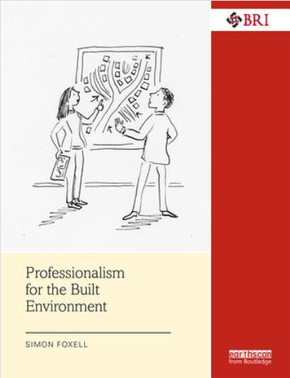
Professionalism for the Built Environment, was written by architect Simon Foxell and published by Routledge in August 2018.
Coming in the aftermath of the Grenfell Tower Fire, this 382-page book offers a thought-provoking assessment of the relationship between society, the economy and professionalism in the built environment. It considers the changing nature of professionalism, and the conflict between self-interest and the wider obligation professionals have to act in the public service, suggesting that there has been a move away from public service under the pressures of the market. Foxell contends that this has ‘shredded many of the core values of professionalism’.
The book outlines the history of professionalism, comparing the development of civil engineering, architecture and surveying. It examines how their systems have developed and where they are now, and highlights the prevalence and power of the large professional services companies.
The book suggests professionalism is under threat, and considers a number of options the professions might adopt for the future, whilst also asking difficult questions about ethics, training, education, public trust and expectations from within and from outside the industry. It concludes with a six-point plan for the professions if they are to remain relevant.
Foxell accepts there is no suggestion professionalism will become redundant, writing; ‘If anything, the need for the honest and impartial intermediary role will increase as society grapples with how to control ever more powerful market players and protect the interests of individuals and society.’
John Worthington, Co-founder of DEGW, former Commissioner of the Independent Transport Commission and Director of The Academy of Urbanism said; “Professionalism for the Built Environment raises our awareness of the foundations of professional society and sets the agenda for a radical reappraisal of the educational and institutional structures we may require in the future. This book stimulates debate on the professions’ responsibilities to civil society, company and self. It provides an authoritative briefing for practitioners, educators, clients and all concerned with creating a built environment that is equitable, fosters wellbeing and improves livelihoods.”
You can purchase Professionalism for the Built Environment at https://www.routledge.com/Professionalism-for-the-Built-Environment/Foxell/p/book/9781138900219
[edit] Related articles on Designing Buildings Wiki
- ARB code of conduct.
- Best practice.
- Conservation Professional Practice Principles.
- Construction industry institutes and associations.
- Ethics in construction.
- Giving professional advice to friends - a case study.
- How to give professional advice to friends.
- Practice.
- Professional conduct in the construction industry.
- Professional practice.
- Professional standards for architects.
- RIBA.
- RIBA professional conduct guidance.
- RICS.
- Submission of evidence to the Edge commission of inquiry on future professionalism.
- The Institution of Civil Engineers.
Featured articles
Check out some of the best features and news from Designing Buildings as well as key stories from around the web.
ECA's reflections on Party Conference season

Burnham wants to be confident of winning before asking for a fresh mandate.
New Chief Construction and Scientific Adviser

Sergio Cavalaro, Professor of Infrastructure Systems at Loughborough University.
Building safety levy for England

CIAT publish estimator tool for members.

Water sector faces a growing crisis that could slow the delivery of vital infrastructure.
Undervaluing our industrial past

Heritage value changes as taste for building styles changes.
Changing expectations around competence and compliance

New information sheet from CIAT.
Grenfell investigation files passed to CPS

Angela Rayner apologises on behalf of the British state.

Electrical contractors need to understand the practical implications.

The real barrier to getting more value from digital technology.

Your guide to The Construction Reset at UKCW Birmingham.

Accommodating the Victorian and Edwardian working woman. Book review.
Rethinking passive fire protection in design

PFP demands the same level of design rigour as structure or services.